Wednesday, June 16, 2010

The Meaning of Force

The Meaning of Force

A force is a push or pull upon an object resulting from the object's interaction with another object. Whenever there is an interaction between two objects, there is a force upon each of the objects. When the interaction ceases, the two objects no longer experience the force. Forces only exist as a result of an interaction.

For simplicity sake, all forces (interactions) between objects can be placed into two broad categories:

  • contact forces, and
  • forces resulting from action-at-a-distance

Contact forces are those types of forces which result when the two interacting objects are perceived to be physically contacting each other. Examples of contact forces include frictional forces, tensional forces, normal forces, air resistance forces, and applied forces.

Action-at-a-distance forces are those types of forces which result even when the two interacting objects are not in physical contact with each other, yet are able to exert a push or pull despite their physical separation. Examples of action-at-a-distance forces include gravitational forces. For example, the sun and planets exert a gravitation pull each other despite their large spatial separation. Even when your feet leave the earth and you are no longer in physical contact with the earth, there is a gravitational pull between you and the Earth. Electric forces are action-at-a-distance forces. For example, the protons in the nucleus of an atom and the electrons outside the nucleus experience an electrical pull towards each other despite their small spatial separation. And magnetic forces are action-at-a-distance forces. For example, two magnets can exert a magnetic pull on each other even when separated by a distance of a few centimeters.

Examples of contact and action-at-distance forces are listed in the table below.

Contact Forces

Action-at-a-Distance Forces

Frictional Force
Gravitational Force
Tension Force
Electrical Force
Normal Force
Magnetic Force
Air Resistance Force

Applied Force

Spring Force

Force is a quantity which is measured using the standard metric unit known as the Newton. A Newton is abbreviated by a "N." To say "10.0 N" means 10.0 Newtons of force. One Newton is the amount of force required to give a 1-kg mass an acceleration of 1 m/s/s. Thus, the following unit equivalency can be stated:

A force is a vector quantity. A vector quantity is a quantity which has both magnitude and direction. To fully describe the force acting upon an object, you must describe both the magnitude (size or numerical value) and the direction. Thus, 10 Newtons is not a full description of the force acting upon an object. In contrast, 10 Newtons, downwards is a complete description of the force acting upon an object; both the magnitude (10 Newtons) and the direction (downwards) are given.

Because a force is a vector which has a direction, it is common to represent forces using diagrams in which a force is represented by an arrow.The size of the arrow is reflective of the magnitude of the force and the direction of the arrow reveals the direction which the force is acting. (Such diagrams are known as free-body diagrams). Furthermore, because forces are vectors, the affect of an individual force upon an object is often canceled by the affect of another force. For example, the affect of a 20-Newton upward force acting upon a book is canceled by the affect of a 20-Newton downward force acting upon the book. In such instances, it is said that the two individual forces balance each other; there would be no unbalanced force upon the book.

Other situations could be imagined in which two of the individual vector forces cancel each other ("balance"), yet a third individual force exists that is not balanced by another force. For example, imagine a book sliding across the rough surface of a table from left to right. The downward force of gravity and the upward force of the table supporting the book act in opposite directions and thus balance each other. However, the force of friction acts leftwards, and there is no rightward force to balance it. In this case, an unbalanced force upon the book to change its state of Motion.


Polarization

Polarization

A light wave is an electromagnetic wave which travels through the vacuum of outer space. Light waves are produced by vibrating electric charges. For our purposes, it is sufficient to merely say that an electromagnetic wave is a transverse wave which has both an electric and a magnetic component.

Let's suppose that we use the customary slinky to model the behavior of an electromagnetic wave. As an electromagnetic wave traveled towards you, then you would observe the vibrations of the slinky occurring in more than one plane of vibration. This is quite different than what you might notice if you were to look along a slinky and observe a slinky wave traveling towards you. Indeed, the coils of the slinky would be vibrating back and forth as the slinky approached; yet these vibrations would occur in a single plane of space. That is, the coils of the slinky might vibrate up and down or left and right. Yet regardless of their direction of vibration, they would be moving along the same linear direction as you sighted along the slinky. If a slinky wave were an electromagnetic wave, then the vibrations of the slinky would occur in multiple planes. Unlike a usual slinky wave, the electric and magnetic vibrations of an electromagnetic wave occur in numerous planes. A light wave which is vibrating in more than one plane is referred to as unpolarized light. Light emitted by the sun, by a lamp in the classroom, or by a candle flame is unpolarized light. Such light waves are created by electric charges which vibrate in a variety of directions, thus creating an electromagnetic wave which vibrates in a variety of directions. This concept of unpolarized light is rather difficult to visualize. In general, it is helpful to picture unpolarized light as a wave which has an average of half its vibrations in a horizontal plane and half of its vibrations in a vertical plane.

It is possible to transform unpolarized light into polarized light. Polarized light waves are light waves in which the vibrations occur in a single plane. The process of transforming unpolarized light into polarized light is known as polarization. There are a variety of methods of polarizing light. The four methods discussed on this page are :

Tuesday, June 15, 2010

Two Rules of Reflection for Concave Mirrors

Two Rules of Reflection for Concave Mirrors

Light always reflects according to the law of reflection, regardless of whether the reflection occurs off a flat surface or a curved surface. Using reflection laws allows one to determine the image location for an object. The image location is the location where all reflected light appears to diverge from. Thus to determine this location demands that one merely needs to know how light reflects off a mirror. The image of an object for a concave mirror was determined by tracing the path of light as it emanated from an object and reflected off a concave mirror. The image was merely that location where all reflected rays intersected. The use of the law of reflection to determine a reflected ray is not an easy task. For each incident ray, a normal line at the point of incidence on a curved surface must be drawn and then the law of reflection must be applied. A simpler method of determining a reflected ray is needed.

The simpler method relies on two rules of reflection for concave mirrors. They are:
  • Any incident ray traveling parallel to the principal axis on the way to the mirror will pass through the focal point upon reflection.
  • Any incident ray passing through the focal point on the way to the mirror will travel parallel to the principal axis upon reflection.

These two rules of reflection are illustrated in the diagram below.

These two rules will greatly simplify the task of determining the image locations for objects placed in front of concave mirrors. These two rules will be applied to determine the location, orientation, size and type of image produced by a concave mirror. As the rules are applied in the construction of ray diagrams, do not forget the fact that the law of reflection holds for each of these rays. It just so happens that when the law of reflection is applied for a ray (either traveling parallel to the principal axis or passing through F) which strikes the mirror at a location near the principal axis, the ray will reflect in close approximation with the above two rules.

Spherical Aberration

Spherical Aberration

Aberration - a departure from the expected or proper course.

Spherical mirrors have an aberration. There is an intrinsic defect with any mirror which takes on the shape of a sphere. This defect prohibits the mirror from focusing all the incident light from the same location on an object to a precise point. The defect is most noticeable for light rays striking the outer edges of the mirror. Rays which strike the outer edges of the mirror fail to focus in the same precise location as light rays which strike the inner portions of the mirror. While light rays originating at the same location on an object reflect off the mirror and focus to a point, any light rays striking the edges of the mirror fail to focus at that same point. The result is that the images of objects as seen in spherical mirrors are often blurry.
The diagram below shows six incident rays traveling parallel to the principal axis and reflecting off a concave mirror. The six corresponding reflected rays are also shown. In the diagram we can observe a departure from the expected or proper course; there is an aberration. The two incident rays which strike the outer edges (top and bottom) of the concave mirror fail to pass through the focal point. This is a departure from the expected or proper course.

This problem is not limited to light which is incident upon the mirror and traveling parallel to the principal axis. Any incident ray which strikes the outer edges of the mirror is subject to this departure from the expected or proper course. A common Physics demonstration utilizes a large demonstration mirror and a candle. The image of the candle is first projected upon a screen and focused as closely as possible. While the image is certainly discernible, it is slightly blurry. Then a cover is placed over the outer edges of the large demonstration mirror. The result is that the image suddenly becomes more clear and focused. When the problematic portion of the mirror is covered so that it can no longer focus (or mis-focus) light, the image appears more focused.
Spherical aberration is most commonly corrected by use of a mirror with a different shape. Usually, a parabolic mirror is substituted for a spherical mirror. The outer edges of a parabolic mirror have a significantly different shape than that of a spherical mirror. Parabolic mirrors create sharp, clear images which lack the blurriness which is common to those images produced by spherical mirrors.

The Law of Reflection

The Law of Reflection

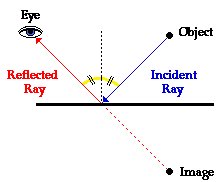
Light is known to behave in a very predictable manner. If a ray of light could be observed approaching and reflecting off of a flat mirror, then the behavior of the light as it reflects would follow a predictable law known as the law of reflection. The diagram below illustrates the law of reflection.
In the diagram, the ray of light approaching the mirror is known as the incident ray (labeled I in the diagram). The ray of light which leaves the mirror is known as the reflected ray (labeled R in the diagram). At the point of incidence where the ray strikes the mirror, a line can be drawn perpendicular to the surface of the mirror. This line is known as a normal line (labeled N in the diagram). The normal line divides the angle between the incident ray and the reflected ray into two equal angles. The angle between the incident ray and the normal is known as the angle of incidence. The angle between the reflected ray and the normal is known as the angle of reflection. (These two angles are labeled with the Greek letter "theta" accompanied by a subscript; read as "theta-i" for angle of incidence and "theta-r" for angle of reflection.) The law of reflection states that when a ray of light reflects off a surface, the angle of incidence is equal to the angle of reflection.

To view an image of a pencil in a mirror, you must sight along a line at the image location. As you sight at the image, light travels to your eye along the path shown in the diagram below. The diagram shows that the light reflects off the mirror in such a manner that the angle of incidence is equal to the angle of reflection.

It just so happens that the light which travels along the line of sight to your eye follows the law of reflection. (The reason for this will be discussed later in Lesson 2). If you were to sight along a line at a different location than the image location, it would be impossible for a ray of light to come from the object, reflect off the mirror according to the law of reflection, and subsequently travel to your eye. Only when you sight at the image, does light from the object reflect off the mirror in accordance with the law of reflection and travel to your eye. This truth is depicted in the diagram below.
For example, in Diagram A above, the eye is sighting along a line at a position above the actual image location. For light from the object to reflect off the mirror and travel to the eye, the light would have to reflect in such a way that the angle of incidence is less than the angle of reflection. In Diagram B above, the eye is sighting along a line at a position below the actual image location. In this case, for light from the object to reflect off the mirror and travel to the eye, the light would have to reflect in such a way that the angle of incidence is more than the angle of reflection. Neither of these cases would follow the law of reflection. In fact, in each case, the image is not seen when sighting along the indicated line of sight. It is because of the law of reflection that an eye must sight at the image location in order to see the image of an object in a mirror.

Momentum

Momentum

Momentum is a commonly used term in sports. A team that has the momentum is on the move and is going to take some effort to stop. A team that has a lot of momentum is really on the move and is going to be hard to stop. Momentum is a physics term; it refers to the quantity of motion that an object has. A sports team which is on the move has the momentum. If an object is in motion (on the move) then it has momentum.

Momentum can be defined as "mass in motion." All objects have mass; so if an object is moving, then it has momentum - it has its mass in motion. The amount of momentum which an object has is dependent upon two variables: how much stuff is moving and how fast the stuff is moving. Momentum depends upon the variables mass and velocity. In terms of an equation, the momentum of an object is equal to the mass of the object times the velocity of the object.

Momentum = mass • velocity

In physics, the symbol for the quantity momentum is the lower case "p". Thus, the above equation can be rewritten as
p = m • v

where m is the mass and v is the velocity. The equation illustrates that momentum is directly proportional to an object's mass and directly proportional to the object's velocity.

The units for momentum would be mass units times velocity units. The standard metric unit of momentum is the kg•m/s. While the kg•m/s is the standard metric unit of momentum, there are a variety of other units which are acceptable (though not conventional) units of momentum. Examples include kg•mi/hr, kg•km/hr, and g•cm/s. In each of these examples, a mass unit is multiplied by a velocity unit to provide a momentum unit. This is consistent with the equation for momentum.

Momentum is a vector quantity. As discussed in an earlier unit, a vector quantity is a quantity which is fully described by both magnitude and direction. To fully describe the momentum of a 5-kg bowling ball moving westward at 2 m/s, you must include information about both the magnitude and the direction of the bowling ball. It is not enough to say that the ball has 10 kg•m/s of momentum; the momentum of the ball is not fully described until information about its direction is given. The direction of the momentum vector is the same as the direction of the velocity of the ball. In a previous unit, it was said that the direction of the velocity vector is the same as the direction which an object is moving. If the bowling ball is moving westward, then its momentum can be fully described by saying that it is 10 kg•m/s, westward. As a vector quantity, the momentum of an object is fully described by both magnitude and direction.

From the definition of momentum, it becomes obvious that an object has a large momentum if either its mass or its velocity is large. Both variables are of equal importance in determining the momentum of an object. Consider a Mack truck and a roller skate moving down the street at the same speed. The considerably greater mass of the Mack truck gives it a considerably greater momentum. Yet if the Mack truck were at rest, then the momentum of the least massive roller skate would be the greatest. The momentum of any object which is at rest is 0. Objects at rest do not have momentum - they do not have any "mass in motion." Both variables - mass and velocity - are important in comparing the momentum of two objects.

The momentum equation can help us to think about how a change in one of the two variables might affect the momentum of an object. Consider a 0.5-kg physics cart loaded with one 0.5-kg brick and moving with a speed of 2.0 m/s. The total mass of loaded cart is 1.0 kg and its momentum is 2.0 kg•m/s. If the cart was instead loaded with three 0.5-kg bricks, then the total mass of the loaded cart would be 2.0 kg and its momentum would be 4.0 kg•m/s. A doubling of the mass results in a doubling of the momentum.

Similarly, if the 2.0-kg cart had a velocity of 8.0 m/s (instead of 2.0 m/s), then the cart would have a momentum of 16.0 kg•m/s (instead of 4.0 kg•m/s). A quadrupling in velocity results in a quadrupling of the momentum. These two examples illustrate how the equation p = m•v serves as a "guide to thinking" and not merely a "plug-and-chug recipe for algebraic problem-solving."

Refraction and Sight

Refraction and Sight

Refraction and Sight was emphasized that we are able to see because light from an object can travel to our eyes. Every object that can be seen is seen only because light from that object travels to our eyes. As you look at Mary in class, you are able to see Mary because she is illuminated with light and that light reflects off of her and travels to your eye. In the process of viewing Mary, you are directing your sight along a line in the direction of Mary. If you wish to view the top of Mary's head, then you direct your sight along a line towards the top of her head. If you wish to view Mary's feet, then you direct your sight along a line towards Mary's feet. And if you wish to view the image of Mary in a mirror, then you must direct your sight along a line towards the location of Mary's image. This directing of our sight in a specific direction is sometimes referred to as the line of sight.

As light travels through a given medium, it travels in a straight line. However, when light passes from one medium into a second medium, the light path bends. Refraction takes place. The refraction occurs only at the boundary. Once the light has crossed the boundary between the two media, it continues to travel in a straight line. Only now, the direction of that line is different than it was in the former medium. If when sighting at an object, light from that object changes media on the way to your eye, a visual distortion is likely to occur. This visual distortion is witnessed if you look at a pencil submerged in a glass half-filled with water. As you sight through the side of the glass at the portion of the pencil located above the water's surface, light travels directly from the pencil to your eye. Since this light does not change medium, it will not refract. (Actually, there is a change of medium from air to glass and back into air. Because the glass is so thin and because the light starts and finished in air, the refraction into and out of the glass causes little deviation in the light's original direction.) As you sight at the portion of the pencil which was submerged in the water, light travels from water to air (or from water to glass to air). This light ray changes medium and subsequently undergoes refraction. As a result, the image of the pencil appears to be broken. Furthermore, the portion of the pencil which is submerged in water appears to be wider than the portion of the pencil which is not submerged. These visual distortions are explained by the refraction of light.